Geometry with a Job
A curve can redirect force. A hinge can preserve a waterway. Start with the task and the unexpected shape becomes legible.
Make room without raising the whole route
A pedestrian crossing works best when it connects naturally to the ground on either bank. Boats may need much more clearance than pedestrians do. One answer is a high fixed bridge with long approaches. Another is a low bridge that moves when navigation requires it.
The Gateshead Millennium Bridge crosses the River Tyne between Gateshead and Newcastle upon Tyne. Its curved deck and supporting arch tilt as a linked assembly, lifting the deck to create a navigation opening. The visual surprise follows a practical requirement: maintain an accessible everyday crossing while allowing vessels through at scheduled times.
Movement adds obligations. The bridge must be stable in its closed position, during the opening sequence and when fully open. Bearings, hydraulic systems, controls and operating procedures become as important to its function as the main structural members. A movable bridge is both a structure and a machine.
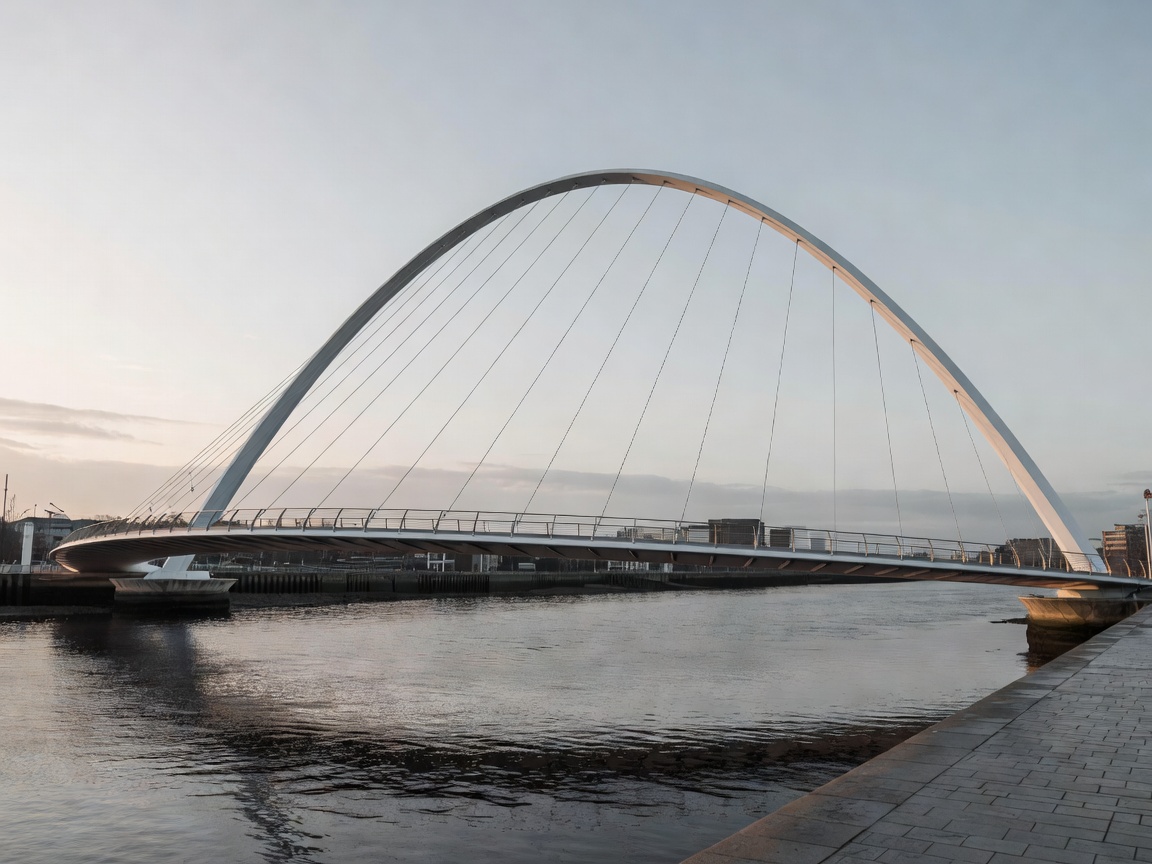
Actual operation follows the owner’s procedures and safety systems.
Fold the crossing instead of swinging it
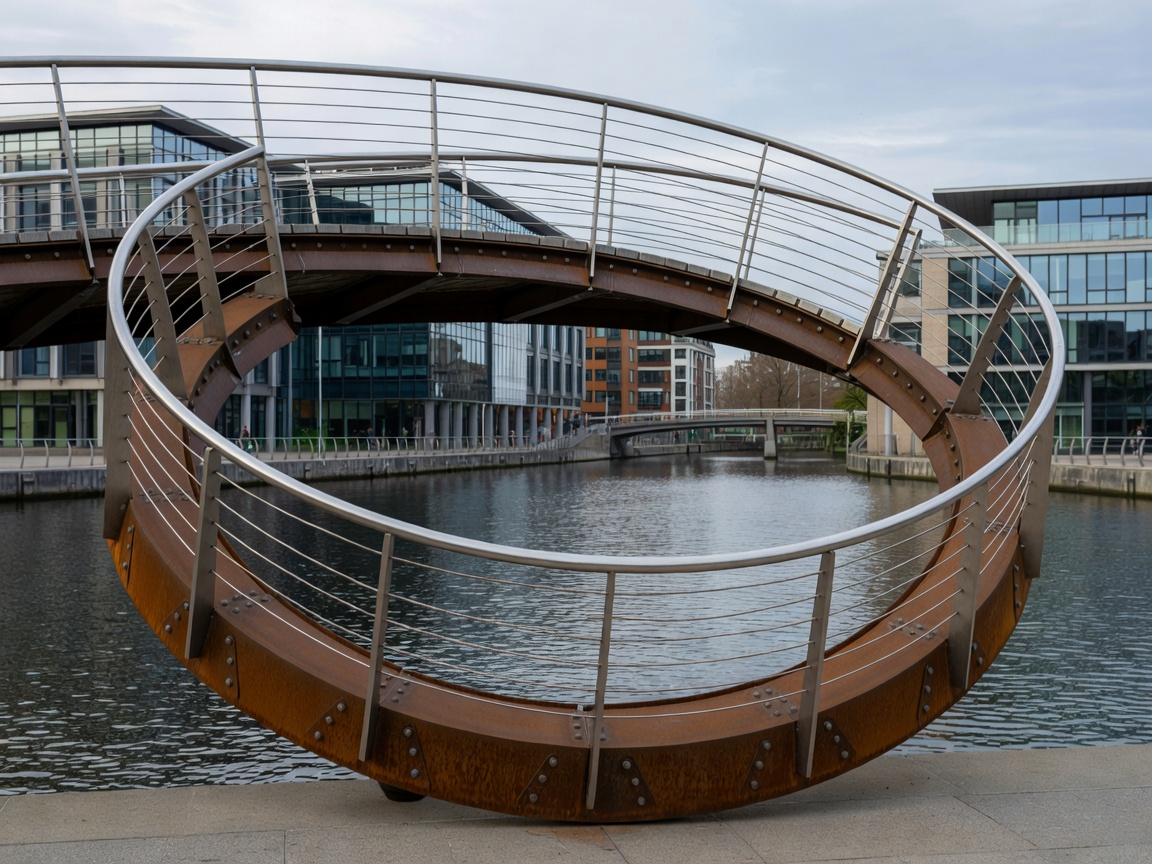
At Paddington Basin in London, the Rolling Bridge uses a sequence of articulated sections to curl into a compact form. Designed by Heatherwick Studio, it offers a notably different response to a small waterway from the more familiar bascule bridge, whose leaf rotates upward about a hinge.
The important idea is controlled geometry. Joints and actuators guide separate segments through a coordinated transformation. When the bridge is available for crossing, its connections must provide the required structural behaviour. During movement, the system has to manage changing positions and forces without relying on the assumptions of the closed state.
Such a design is not automatically a better answer for every canal. Mechanisms need maintenance, and local operating needs determine whether an unusual movement is useful. The bridge is most illuminating as a particular solution to a particular site, rather than a universal replacement for simpler opening spans.
Balance can become a landscape
Scotland’s Forth Bridge makes a different kind of structural drama. Its great steel cantilevers project outward from major supports, with suspended spans completing the railway crossing between them. A cantilever is a member or system that extends beyond its support; the forces have to be balanced and carried back through the supporting structure.
The deep triangular framework is not decorative lacework. A truss arranges members so that much of the load can be carried through axial tension and compression, although real joints and members also require more detailed analysis. Structural depth helps resist bending, and the bridge’s large-scale geometry makes that depth visible from a distance.
The Forth Bridge opened in 1890 and is inscribed on UNESCO’s World Heritage List. Its historical importance does not remove the need for ongoing inspection and maintenance. Long service is an operational achievement as well as a consequence of the original design.
An arch sends force sideways too
The Pont du Gard in southern France carries an ancient Roman aqueduct rather than a modern highway. Its stacked stone arches illustrate a principle that remains useful: an arch can guide loads primarily through compression toward its supports. But the supports must also cope with horizontal thrust.
This is why an arch cannot be understood by tracing only a vertical line down from the crown. Its shape and support conditions influence where the resultant force travels through the masonry. Settlement or displaced supports can change that relationship. The apparent serenity of an old stone arch conceals a very specific balance of geometry, weight and restraint.
Modern tied arches make another arrangement possible: a tie can resist the outward pull that would otherwise be delivered more directly to the abutments. The visible bow may look familiar, yet the route taken by horizontal force can be quite different.
| Example | Constraint | Structural response |
|---|---|---|
| Gateshead Millennium Bridge | Pedestrian access and navigation | Tilting deck-and-arch assembly |
| Rolling Bridge, Paddington | A compact opening over a small inlet | Articulated curling sections |
| Forth Bridge | A major railway crossing | Cantilevers and suspended spans |
| Pont du Gard | Carry an aqueduct across a valley | Multiple tiers of masonry arches |
Unusual does not mean arbitrary
Architecture, civic identity and the visitor experience can influence a bridge alongside its structural needs. That does not make every curve a direct diagram of force. Good reading means distinguishing what carries load, what provides enclosure or access, and what gives the crossing a public identity.
Before calling a form extravagant, ask what it has to carry, what must pass beneath it, how much room its approaches have and whether it has to move. Those four questions often explain more than a photograph alone can.