A Crossing on Buoyancy
When foundations become difficult, water itself can carry the road. Keeping that road in place is the next problem.
Replace piers with displacement
A conventional bridge takes vertical loads through supports into the ground. A floating bridge can send much of that load into the water instead. Hollow pontoons displace water; the resulting buoyant force balances their own weight, the supported structure and the traffic above.
Concrete can float when it forms a watertight hollow body with sufficient displaced volume. The material alone does not decide whether an object floats. The relationship between total mass and the volume of displaced water does. A concrete pontoon is closer in principle to a ship’s hull than to a solid block dropped into a lake.
Designers need reserve buoyancy, suitable freeboard and a credible response to damage. Internal compartments can limit how far flooding spreads, but they do not make leakage harmless. Inspection, drainage arrangements and watertight details remain essential parts of the structure.
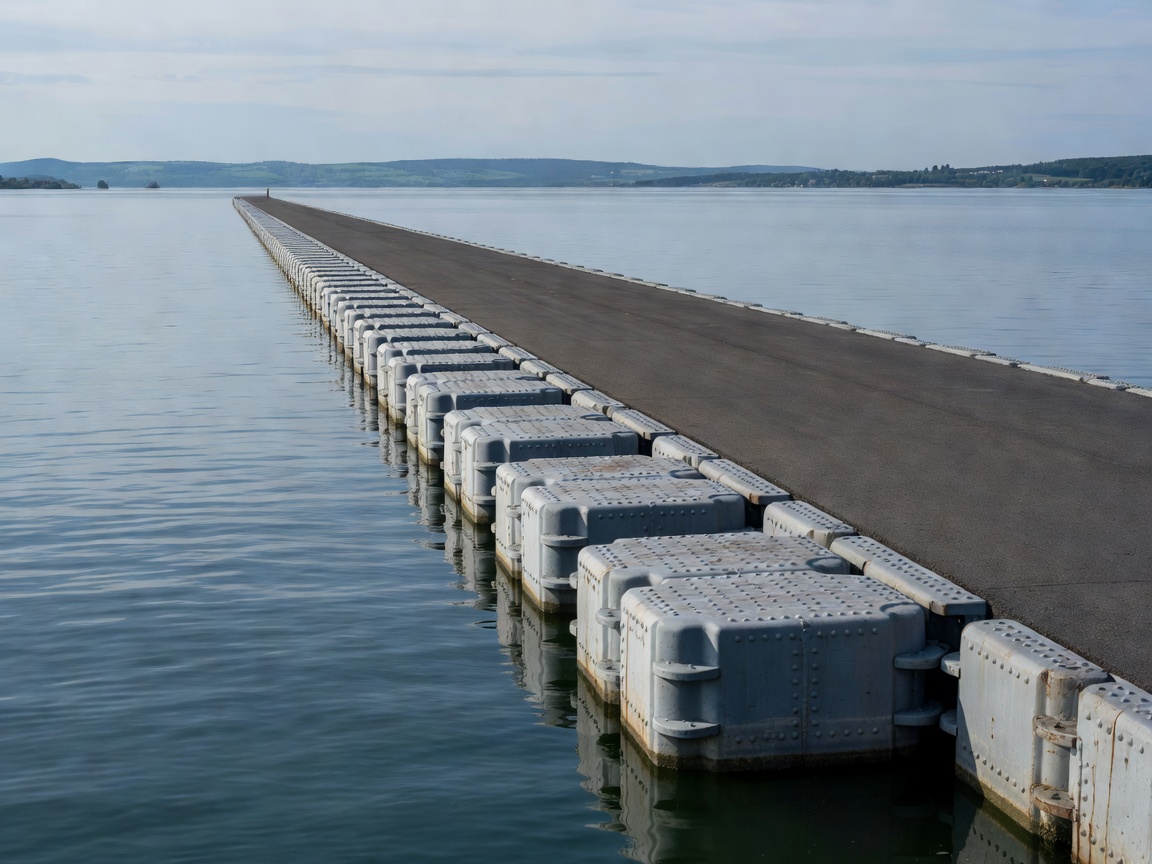
This illustrates force balance, not a design calculation.
A deep lake changes the options
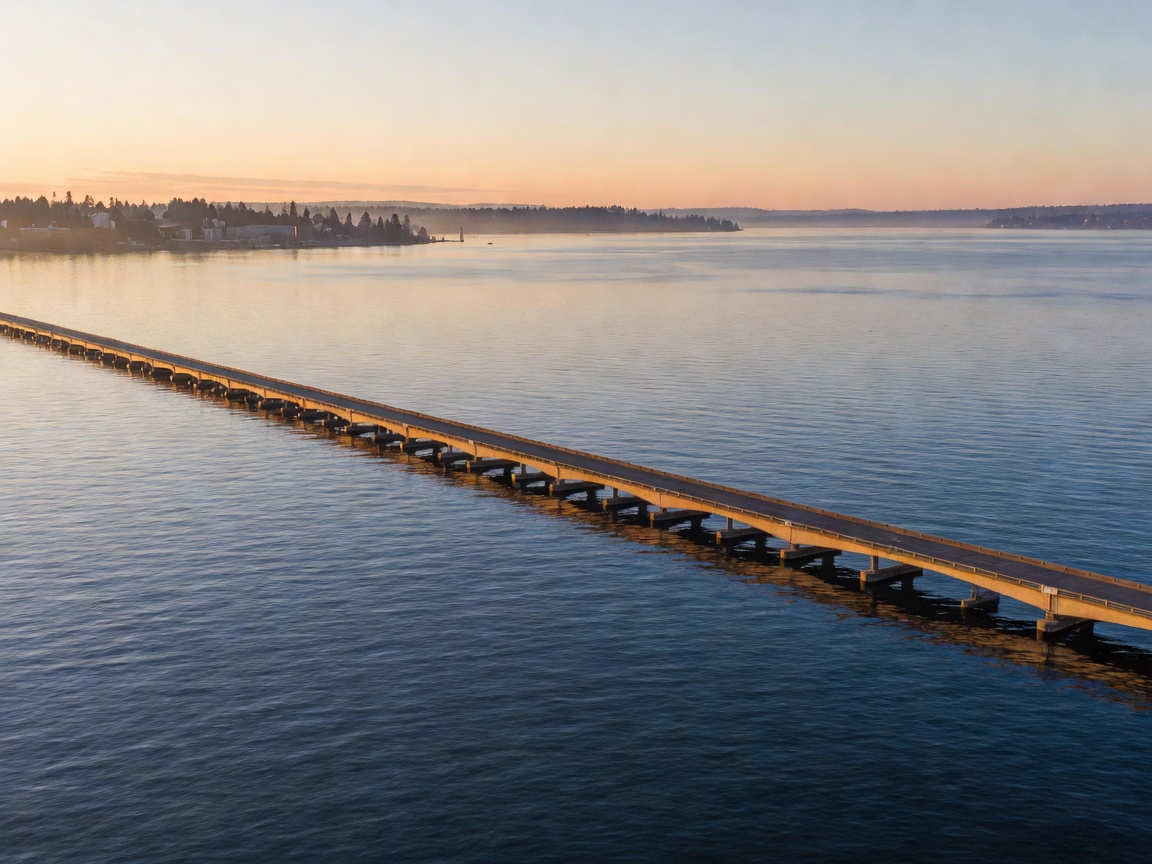
Lake Washington, beside Seattle, provides a useful real-world setting. Deep water and soft lake-bed deposits make conventional foundations challenging. Floating crossings offer another way to support the route, although the approaches and transition structures still need substantial engineering.
The SR 520 crossing is named the Evergreen Point Floating Bridge. Its replacement floating bridge opened in 2016. WSDOT describes a system of interconnected concrete pontoons held by an anchoring arrangement, with elevated roadway elements above. That road is not a free-floating raft: support and restraint are designed as an integrated crossing.
Elsewhere on the lake, the I-90 corridor includes the Lacey V. Murrow Memorial Bridge and the Homer M. Hadley Memorial Bridge. Their proximity does not make them interchangeable. Separate structures have different histories, layouts and operating requirements. Always identify the particular bridge before borrowing a dimension or a construction story.
Floating is not the same as drifting
Wind, waves, current and vehicle actions can push a bridge sideways or rotate its components. Mooring cables and anchors may resist these movements. Their forces change as the floating structure moves, and the relationship between restraint and flexibility must be understood across the expected operating conditions.
Not every floating bridge uses the same mooring strategy. Norway’s Nordhordland Bridge combines a floating section with a cable-stayed navigation span. Its floating portion relies on a different restraint arrangement from a typical individually anchored pontoon crossing. Norway’s Bergsøysund Bridge is another important example of how overall geometry and end restraint can contribute to a floating system.
The lesson is to avoid treating “floating bridge” as one standard detail. The term describes a support principle. It does not specify how every force reaches shore or the bed below.
The difficult place is often the connection
Water levels change. Waves produce relative motion. A floating section and a land-supported approach do not respond in exactly the same way. Transition spans, joints and bearings have to accommodate that difference while providing a usable roadway.
The problem is three-dimensional. A structure may move vertically, sideways and rotationally; its connections cannot be selected by thinking only about a gentle rise and fall. Repeated movement also raises fatigue questions. A detail that survives one large action may still need careful assessment for many smaller cycles.
Navigation adds another constraint. A low floating deck can obstruct boats, so a route may need a separate elevated channel, a movable section or restrictions on vessel access. Those choices affect the alignment, cost and day-to-day operation of the entire crossing.
| Question | What to investigate |
|---|---|
| What carries the weight? | Pontoon displacement and the deck’s distribution of loads. |
| What prevents drift? | Moorings, end restraints, geometry or a combination. |
| How do vessels pass? | Navigation spans, opening arrangements and operating restrictions. |
Read the water, not just the roadway
From a designated public viewpoint, notice how close the floating portion sits to the surface and how it meets the fixed approaches. Look for changes in elevation and the location of navigation openings. Do not infer current safety conditions from calm water or a photograph: wind restrictions and closures belong to the bridge operator’s live information.
A floating crossing is remarkable precisely because it accepts a changing support surface. Instead of eliminating every movement, its design channels movement into manageable forms. That is a more interesting achievement than the simple surprise of seeing concrete afloat.